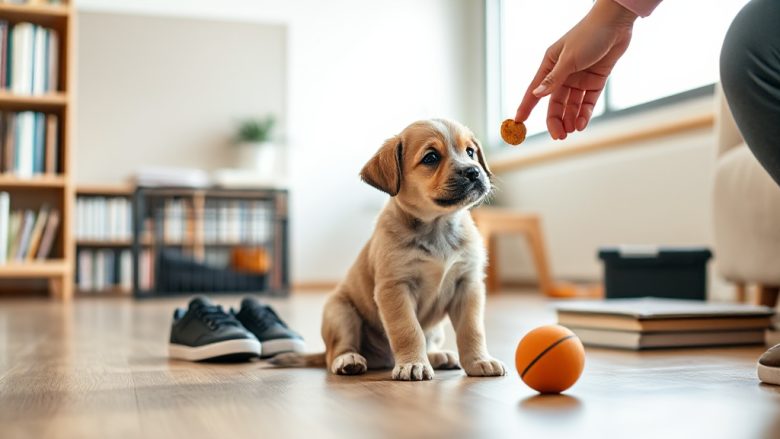
You brought home a puppy and suddenly everyone has a different opinion. Your neighbour swears you must crate train from night one. A friend insists you should let the puppy cry it out. Someone else tells you to ignore accidents completely, while a relative warns that doing so will ruin the dog forever. It’s exhausting, and it’s normal to feel like you’re already behind.
Here’s the good news: the first two weeks are not about perfection. They’re about building a routine your puppy can trust and avoiding a handful of predictable mistakes. These puppy training tips for beginners focus on the five errors that trip up almost every new owner, and what to do instead. None of them require special equipment or a trainer on speed dial.
1. Using Different Words for the Same Cue
It sounds harmless. You say “sit” in the morning, “sit down” after lunch, and “have a seat” when guests arrive. To you, those mean the same thing. To a puppy who has been on this planet for eight weeks, they are three unrelated sounds.
Dogs learn through repetition and consistency. If the word changes, the behaviour doesn’t stick. Pick one word per behaviour and never rotate it. “Sit” stays “sit.” “Down” means lie down, not get off the sofa — use “off” for that. “Come” means come to me, every single time, not just when you’re holding a treat.
This also applies to the whole household. If your partner says “down” while you say “off,” your puppy will spend weeks guessing. Have a five-minute conversation with everyone in the house and agree on a short list: sit, down, stay, come, leave it, off. Write it on the fridge if you have to. That single step will speed up training more than any gadget or course.
And keep your tone steady. A cheerful “yes!” when your puppy gets it right is worth more than a long explanation. Puppies read pitch and timing far better than vocabulary.
2. Giving Too Much Freedom Too Soon
The most common first-week mistake is letting a new puppy roam the whole house. It feels loving. It’s actually overwhelming and it sets up accidents, chewing and barking that you’ll spend months undoing.
Think of it like this: a puppy who has free run of the living room, kitchen and hallway has about a thousand things to chew, sniff and pee on. A puppy in a small, safe space has one bed, one water bowl and one toy. The second puppy learns faster because there is simply less to get wrong.
Start with one room or a playpen. Keep the puppy within sight whenever they’re loose, and use a crate or pen for naps and short breaks. This isn’t cruel — it’s how you prevent the habits you’d otherwise have to fix later. Gradually open up more space as your puppy proves they can handle it, usually one room at a time over several weeks.
If you work from home, a pen next to your desk works well. Your puppy learns to settle while you’re nearby, which is a skill that pays off for years. If you’re out for short stretches, a crate with a safe chew toy is far kinder than a whole house full of hazards.
3. Punishing Accidents Instead of Preventing Them
Coming home to a puddle and shouting at your puppy feels like the obvious response. It isn’t. Puppies don’t connect punishment with something they did twenty minutes ago. All they learn is that you sometimes come home angry, which makes them anxious and more likely to hide and toilet indoors.
Accidents are almost always a management problem, not a disobedience problem. A puppy’s bladder is tiny. They need to go out after waking, after eating, after drinking, after play, and roughly every hour or two during the day. If you’re getting frequent accidents, the fix is more trips outside, not more correction.
Take your puppy to the same spot each time. Stand still, wait, and praise calmly the moment they finish. If nothing happens after five minutes, go back inside and supervise closely, then try again ten minutes later. Clean any indoor accidents with an enzymatic cleaner so the smell doesn’t invite a repeat visit.
One more thing: never rub a puppy’s nose in anything. It doesn’t work, it damages trust, and it makes house training take longer. Patience and timing beat punishment every time.
4. Skipping Socialisation Because You’re Waiting for Vaccinations
There’s a common belief that puppies should stay indoors until their vaccinations are complete. The intention is good, but the result can be a fearful adult dog. The socialisation window closes somewhere around sixteen weeks, and much of it passes while owners are still waiting.
You can socialise safely before the full vaccine course. Carry your puppy in your arms through the park, sit on a bench outside a shop, or watch traffic from a quiet spot. Let them hear buses, see pushchairs, watch children running and listen to bikes. Reward calm behaviour with treats and quiet praise.
Invite vaccinated, friendly adult dogs to your home or garden for short, supervised visits. Keep them brief and positive — five minutes is plenty for a young puppy. If your puppy seems worried, don’t force it. Move further away and let them watch from a distance, then gradually close the gap over several sessions.
Ask your vet about local puppy classes too. Many run sessions in clean, safe spaces before the vaccine course finishes, and they’re one of the best investments you can make in the first month. A puppy who has met twenty new sights, sounds and people by twelve weeks is far easier to live with than one who has met three.
5. Training in Long Sessions Instead of Short, Frequent Ones
New owners often set aside half an hour for training. It sounds diligent. For a puppy, it’s about twenty-five minutes too long.
Young puppies have short attention spans and tire quickly. Five minutes, three or four times a day, beats one long session every time. End while your puppy is still enjoying it, not when they’ve lost interest and started chewing the lead. That way they finish on a win and look forward to the next round.
Keep sessions playful. Practise a sit before meals, a recall in the hallway, a settle on a mat while you make tea. Real life is the best classroom. If your puppy nails something twice in a row, stop and come back later — repetition beyond that point rarely helps and often causes frustration on both sides.
Watch for tiredness signals: yawning, lip licking, turning away, sudden zoomies. Those mean the session is over. A puppy who is overtired can’t learn, and pushing through will only make them dread training. Short, cheerful, frequent practice is the single fastest route to a well-behaved dog.
A Final Word for the Overwhelmed New Owner
If you take nothing else from these puppy training tips for beginners, take this: you don’t need to get everything right in the first two weeks. You need to be consistent, patient and kind. Pick one cue, keep your puppy’s world small at first, prevent accidents instead of punishing them, socialise gently, and keep sessions short.
There will be days when it feels like nothing is working. Then your puppy will sit without being asked, or sleep through the night, or come running when you call, and it will click. Progress in puppy training is rarely a straight line. It’s a series of small, boring, repeated moments that add up to a dog you actually enjoy living with.
You’re not behind. You’re just at the beginning. That’s exactly where every good dog owner starts.