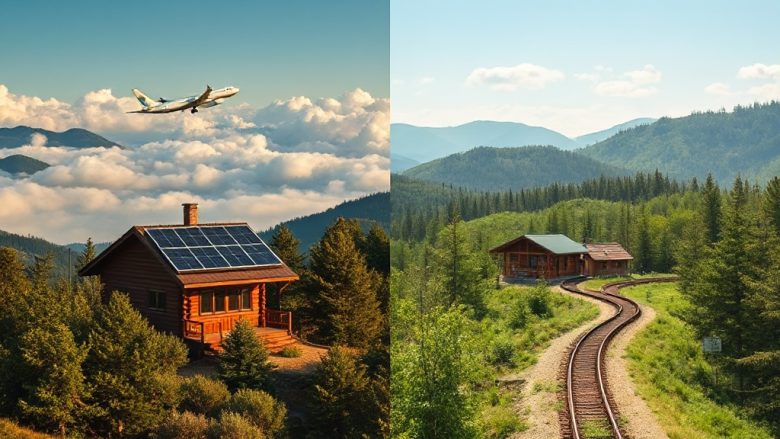
You want to see the world without making it worse. That’s the easy part. The hard part is knowing when eco travel is genuinely better and when it’s just a label. I’ve slept in a bamboo hut with a bucket shower and I’ve taken a £30 flight across a continent because it was the only way to make the trip happen. Both choices felt defensible in the moment. Only one of them was green in any meaningful sense. This article lays out the real trade-offs of eco travel pros and cons explained without pretending there’s a single right answer for everyone.
Eco travel isn’t a binary. It’s a sliding scale of compromises, and the honest version of the conversation admits that. A train journey across Europe might emit a fraction of the equivalent flight, but it costs three times as much and eats two days of your holiday. A locally owned guesthouse might keep money in the community, but its building standards may not meet the efficiency of a modern city hotel. Understanding those tensions is what separates a genuinely greener trip from a guilt-soothed one.
Environmental benefits: what eco travel actually does well
The strongest case for eco travel is that it can reduce the pressure tourism puts on fragile places. When done properly, it directs money toward conservation rather than extraction. A wildlife lodge that employs local guides and funds anti-poaching patrols is doing something a chain resort on the same land almost certainly wouldn’t. The economics matter: if protecting a forest pays better than clearing it, the forest tends to stay standing.
Transport is where the biggest measurable wins sit. A long-distance train trip typically produces a small fraction of the emissions of the equivalent short-haul flight per passenger. Buses and shared minivans, common in much of Asia, Latin America and East Africa, are similarly efficient per person. Choosing overland travel for shorter legs is one of the few eco choices with a clear, quantifiable benefit rather than a vague feeling of virtue.
There’s also the demand-side effect. When travellers consistently choose places that treat staff well, limit waste and protect habitat, it shifts what operators think they can get away with. That pressure is slow and imperfect, but it’s real. Destinations that once tolerated plastic-choked beaches and exploited labour have cleaned up when the market rewarded it.
And there’s a personal benefit that often gets dismissed as fluffy but isn’t. Slower travel tends to be more memorable. Taking a night train instead of a flight, eating where the staff eat, staying somewhere small enough that the owner remembers your name — these produce better trips, not just greener ones. The environmental and experiential cases overlap more than people expect.
Personal benefits: why greener trips often feel better
Eco travel usually means spending money closer to the ground. That translates into meals cooked with local ingredients, guides who grew up in the area and accommodation that reflects the place rather than a generic international template. You get less of the bubble and more of the actual destination.
It also tends to be slower, which is a feature rather than a bug. When you can’t fly between every stop, you linger. You take the ferry, you stay an extra night, you notice things. Many people who switch to overland-heavy travel report that their trips became less exhausting and more interesting, even if they covered less ground.
There’s a quieter benefit too: less guilt. If you care about your footprint, the low-grade unease that comes with a carbon-heavy holiday is real. Making deliberate choices doesn’t eliminate the impact, but it does make it easier to enjoy the trip you’re on. That psychological relief is worth something, even if it’s hard to put in a spreadsheet.
Cost: the uncomfortable financial reality
Here’s the part the glossy brochures skip. Eco travel is often more expensive, sometimes dramatically so. Genuinely sustainable lodges tend to be small, which means they can’t spread fixed costs across hundreds of rooms. Solar arrays, composting systems, water recycling and fair wages all cost money. That cost lands on the nightly rate.
Transport is the other sting. Trains and ferries are frequently pricier than budget flights, especially when booked late. A family of four taking the train across a continent can easily spend several times what four discounted airfares would cost. For anyone travelling on a tight budget, the greenest option is sometimes simply unaffordable, and pretending otherwise is dishonest.
There’s also the time cost, which is a form of money for anyone with limited annual leave. A trip that takes three days of travel each way instead of one flight day means fewer days actually being somewhere. Eco travel asks you to trade either cash or time, and most people have a shortage of at least one.
Greenwashing and access: the two biggest cons
Greenwashing is the elephant in the room. The word “eco” has no universal legal definition in most tourism markets. A hotel can call itself eco because it asks you to reuse towels while running air conditioning in every room and flying staff in from abroad. A tour can call itself sustainable because it plants a few trees to offset a flight that emitted far more carbon than those trees will ever absorb.
Some certification schemes are rigorous and independently audited. Others are essentially paid badges. From the outside, they can look identical. That makes it genuinely hard for a traveller to tell a real effort from a marketing exercise, and it means the eco label itself carries less information than it should.
The second big con is access. Eco travel skews toward people with money, time and the cultural confidence to navigate unfamiliar systems. If you’re travelling with young children, have mobility needs, or are working with a tight budget and limited leave, the greener options may be out of reach or impractical. That’s not a moral failing. It’s a structural problem with how green travel is currently packaged and priced.
There’s a fairness issue underneath it too. Telling people in lower-income countries to forgo affordable flights while wealthier travellers take long-haul holidays is a hard sell, and it should be. The burden of going green can’t fall only on those least able to carry it.
How to weigh the pros and cons for your own trip
The useful question isn’t “is this trip eco or not?” It’s “where does the biggest impact sit, and can I shift it?” For most trips, transport dominates the carbon footprint. A single long-haul flight can outweigh everything else you do on the ground combined. That means the highest-leverage decision is usually how you get there, not which soap is in the bathroom.
After transport, look at where the money goes. Does it stay local? Does it pay fair wages? Does it support conservation? A guesthouse that keeps profits in the community can be a better choice than a certified eco-resort owned by an international chain, even if the guesthouse’s solar panels are smaller.
Then consider duration. A long trip with one flight is usually greener per day than several short trips with several flights. Staying longer in one place reduces the transport burden per experience and often produces a better holiday anyway.
Finally, be honest about your constraints. If the only affordable way to visit family abroad is to fly, take the flight. Guilt doesn’t reduce emissions. Making the greener choice where you reasonably can, and skipping it where you genuinely can’t, is a more sustainable approach than aiming for purity and burning out.
A simple decision checklist before you book
Before committing to a trip, run through a few quick questions. Can I reach this destination by train, bus or ferry without losing more than a day or two each way? If yes, seriously consider it. If no, can I stay longer to make the flight count? Can I choose accommodation where the money stays in the local economy? Can I verify any eco claim rather than taking the label at face value? And does this trip fit my actual budget and leave allowance, or am I pretending it does?
If the answers point in different directions, that’s normal. Eco travel is a series of trade-offs, not a test you pass or fail. The goal is to make the trade-offs consciously, know where your impact really sits, and avoid paying a premium for a label that doesn’t mean much. Do that, and you’re already ahead of most travellers.
FAQ: eco travel pros and cons explained
Is eco travel always better for the environment?
No. It’s usually better when it reduces flights, keeps money local and supports conservation. But a poorly run eco-lodge can have a higher footprint than a well-managed city hotel, and a green label doesn’t guarantee real impact. Transport choices matter more than most on-the-ground details.
Why is eco travel often more expensive?
Small scale is the main reason. Sustainable lodges have fewer rooms to spread costs across, and investments like solar power, water recycling and fair wages add to the nightly rate. Trains and ferries also tend to cost more than discounted flights, especially when booked close to departure.
How can I tell real eco travel from greenwashing?
Look for specifics rather than slogans. Real efforts usually come with measurable claims: energy sources, waste systems, local employment numbers, conservation funding. Vague phrases like “eco-friendly” or “green” without detail are a warning sign. Independent certification helps, but only if you check who audits it.
Can I do eco travel on a budget?
Yes, with trade-offs. Overland transport, longer stays, locally owned guesthouses and eating where locals eat are all cheaper and greener than the alternatives. The main cost is time. If you have more of that than money, budget eco travel is very achievable.