Between work, family, and everything else, your bike has been gathering dust. Here’s how to get back on it without quitting your job.
I know that dust well. Two years ago my Santa Cruz sat in the garage for five straight months while I convinced myself I’d ride “once things calmed down.” Things never calmed down. What changed wasn’t my schedule — it was my approach. I stopped waiting for the perfect three-hour window and started building rides around the 60 minutes I actually had. Since then I’ve averaged three rides a week as a full-time working parent, and I’m not special. I just got ruthless about time.
Mountain biking for busy people isn’t about squeezing a weekend epic into a Tuesday evening. It’s about accepting that a 45-minute loop you actually ride beats a four-hour plan you keep postponing. The fitness follows. The skills follow. The sanity definitely follows.
The 60-Minute Ride Formula
Most riders overestimate how long a worthwhile ride takes. They picture driving 40 minutes to a trailhead, riding for two hours, then driving home. That’s a half-day commitment, and it’s why the bike stays hanging.
The fix is to shrink every part of the equation except the pedaling. I aim for a total door-to-door time of 60 minutes, and I break it down like this: five minutes to change and grab gear, five minutes of driving or pedaling to the trail, 40 minutes on dirt, then 10 minutes to get home and rinse off. That’s it. It’s not glamorous, but it happens three times a week instead of once a month.
The key is finding a trail close enough that you don’t dread the drive. I spent an afternoon mapping every patch of dirt within a 15-minute radius of my house — a small network behind a school, a fire road up a hill, even a rough field edge that connects to a proper singletrack. None of them are destination trails. All of them are good enough for a real ride. When you’re time-poor, proximity beats quality every single time.
Once you’re on the trail, resist the urge to warm up slowly. Ten minutes of easy spinning, then pick up the pace. I structure most short rides as three hard efforts of five to eight minutes with easy spinning between them. That’s enough to keep my legs honest without leaving me wrecked for the rest of the day. If I only have 30 minutes, I’ll do two efforts and skip the cool-down. Something always beats nothing.
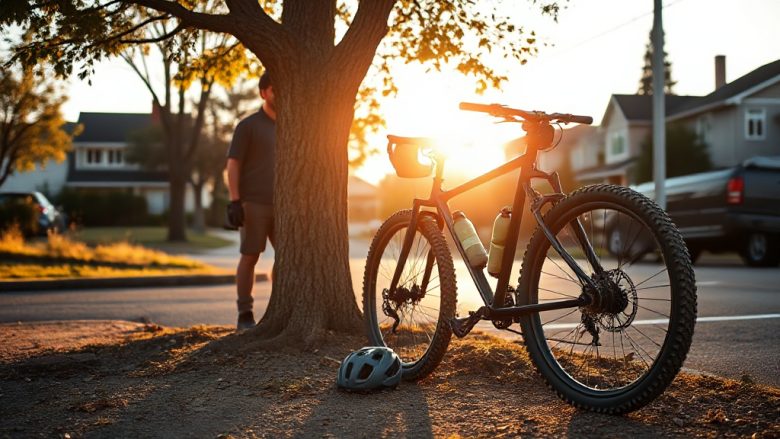
One more thing: leave your bike ready to ride. Mine lives by the door with tires pumped and chain lubed. If I have to dig it out of the back of the garage and fix a flat before I can even start, the ride doesn’t happen. Friction kills momentum, and that’s true for schedules too.
Strength Without the Gym
Here’s the honest truth about riding three times a week on limited time: your body will complain if you don’t support it. Sore backs, aching knees, and that nagging feeling that you’re getting slower instead of faster — most of it comes from weak supporting muscles, not from the bike itself.
The good news is you don’t need a gym membership or an hour of lifting. You need about 15 minutes, two or three times a week, ideally right after a ride when you’re already warm and motivated. I do mine in the garage while dinner cooks.
The movements that matter most for mountain bikers are simple. Single-leg work teaches your knees to track properly over rough ground. Hip hinges build the posterior chain that protects your lower back on long descents. Push-ups and rows keep your upper body from folding under braking. And core work — not crunches, but planks and dead bugs — holds everything together when the trail gets loose.
I keep a kettlebell, a resistance band, and a pull-up bar in the garage. That’s the whole setup. A typical session looks like this: 10 single-leg deadlifts per side, 10 goblet squats, 10 banded rows, a 30-second plank, and 10 push-ups. Two rounds. Done in 15 minutes. It’s not a program you’d find in a training manual, but it’s kept me riding pain-free for two years, and consistency matters more than sophistication when your time is tight.
If you only do one thing, do the single-leg work. It’s the closest thing to a cheat code for trail riding, because almost every technical moment on a bike happens on one leg at a time.
Planning Around Family and Work
The scheduling side is where most people fail, and it’s not because they’re disorganized. It’s because they try to fit riding into whatever time is left over. There is never any time left over. You have to take it deliberately.
I treat my rides like meetings. Two of them go in the calendar at the start of the week — usually a Tuesday and Thursday evening — and one is flexible for the weekend. If something conflicts, the ride moves, but it doesn’t disappear. That distinction matters. A cancelled ride that never gets rescheduled is how you end up back in the dusty-bike club.
Early mornings are the most reliable slot if you can stomach them. Nobody needs anything from you at 5:45am. The trail is empty, the light is good, and you’re home before the house wakes up. It’s brutal for the first two weeks and then it becomes the best part of your day. I resisted it for years and now I guard those mornings fiercely.
Lunch rides are the other underrated option, especially if you work from home or have a flexible office. A 45-minute loop in the middle of the day resets your head better than any amount of coffee. You come back sharper, not more tired.
Whatever you choose, make it a standing appointment and protect it. Tell your family when you’ll be gone and when you’ll be back. Take on a fair share of the household load so the riding time feels earned rather than stolen. My wife and I trade mornings — I ride Tuesday and Thursday, she runs Wednesday and Saturday. Neither of us feels guilty, because it’s balanced. That fairness is what makes the whole thing sustainable.
Don’t chase perfect conditions either. If it’s wet, ride anyway or do a maintenance session in the garage. If you’re tired, do a shorter loop. The goal is showing up, not performing.
Gear That Saves Time
You don’t need much, but the few things you do need should remove friction rather than add it. Every piece of gear that makes a ride easier to start is worth its weight.
A hydration pack you can grab pre-loaded is a small thing that pays off constantly. I fill mine the night before and leave it by the door with my helmet and gloves. When the alarm goes off, I’m dressed and out in five minutes. If I had to hunt for gloves or mix a bottle, I’d talk myself out of the ride half the time.
Tubeless tires are another quiet time-saver. Fewer flats means fewer unscheduled repairs, and nothing kills a short ride faster than fixing a puncture in the dark. Pair them with a quality mini-pump and a plug kit, and you can handle most trailside issues in under five minutes instead of walking home.
Keep a basic tool kit on the bike at all times — multi-tool, spare chain link, tire lever, and a small rag. Don’t unpack it after every ride. The point is that the bike is always ready, so you never have an excuse to skip a session because you need to sort out your gear first.
Clothing is the last piece. I have one outfit that works in most conditions and I don’t think about it. A breathable jersey, padded shorts, and a light shell cover 90% of rides. Choosing what to wear every time is a decision tax you don’t need to pay.
One thing worth spending on: a decent light setup if you’re riding early or late. A reliable bar light and a helmet light make dawn and dusk rides genuinely enjoyable, and they extend your usable hours by a huge margin during shorter days. It’s the single upgrade that most expanded my riding time.
Start Small, Stay Consistent
Here’s the part nobody tells you: the hardest ride is the first one back. After that, it gets easier every time, not because your legs get stronger overnight, but because the habit takes over. Your brain starts to expect the ride, and the excuses get quieter.
Don’t aim for three rides a week starting tomorrow. Aim for one. Get that one ride locked in for two weeks straight, then add a second. Build the habit before you build the volume. I’ve watched friends burn out trying to go from zero to five rides a week, and they quit by week three because it felt like a second job.
Your bike doesn’t need you to be fast. It doesn’t need a race calendar or a training plan. It just needs you to show up, even when the window is small and the trail is local and the ride is short. Those short rides add up. They keep your skills sharp, your head clear, and your love for the sport alive through the busiest years of your life.
So go pump the tires. Set the alarm 45 minutes earlier. Pick the closest patch of dirt and ride it badly for an hour. That’s mountain biking for busy people, and honestly, it might be the best version of it.